
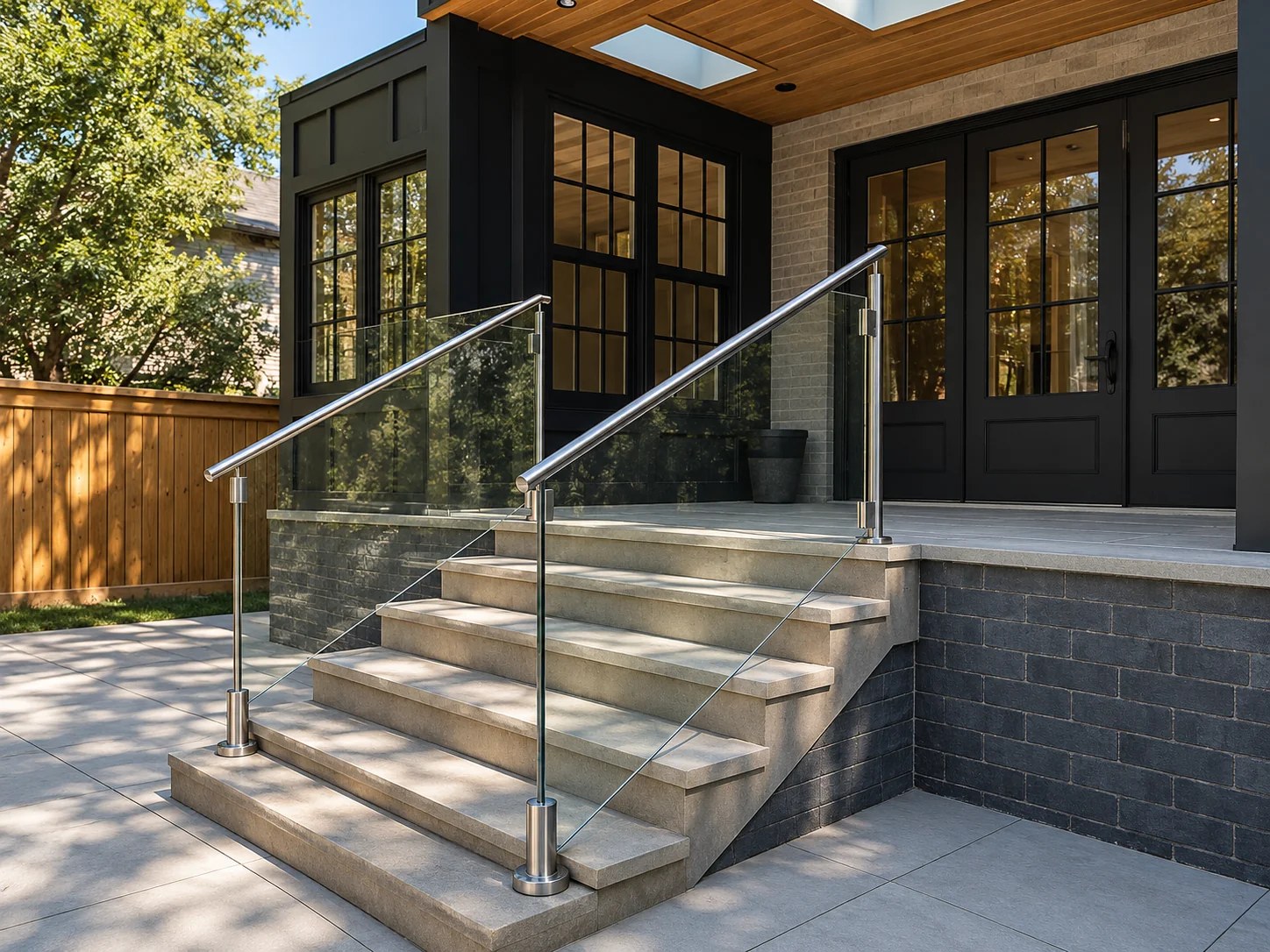
"Tempered or laminated?" comes up on almost every project we quote — railings, table tops, office partitions, wine rooms. Both are safety glass, but they solve different problems. Understanding the difference takes about five minutes and makes every other decision easier.
Tempered glass: built for safe breakage
Tempered glass is a single sheet of glass that's been heated to over 1,000°F and rapidly cooled. The process puts the surface under compression and the core under tension, making it roughly four to five times stronger than ordinary glass. When it does break, it crumbles into small, blunt, pebble-like pieces instead of jagged shards — which is exactly why building codes require it in showers, doors, and anywhere people might fall against glass.
Laminated glass: built for containment
Laminated glass is two or more glass sheets bonded around a tough plastic interlayer (usually PVB). Its defining behavior: when it cracks, it stays in place. The interlayer holds the fragments, so the panel keeps acting as a barrier even after impact. That buys three things tempered glass can't: security (it's far harder to penetrate), post-break safety at height (nothing falls out), and meaningfully better sound dampening and UV blocking.
The practical comparison
- Strength against impact: tempered wins on initial resistance to blunt hits
- Behavior after breaking: laminated wins — it holds together; tempered evacuates the opening
- Sound reduction: laminated wins clearly, thanks to the damping interlayer
- Security: laminated — it's rated by how long it resists being broken through
- Cost: tempered is the more economical safety glass
Where each one belongs
Tempered: shower enclosures, interior doors, table tops, shelving — anywhere the priority is strength plus safe breakage. Laminated: railings on elevated decks and balconies, overhead glass, storefronts, and any panel where a broken piece must not fall out of its frame. Interestingly, showers are the one place laminated is rarely used — tempered's clean crumble is preferred there.
The best of both: tempered-laminated
For demanding applications — exterior railings, large overhead panels, commercial glazing — we often specify glass that is both tempered and laminated: tempered strength, laminated containment. It's the premium spec, and for elevated outdoor guards in Ontario, it's usually the right one.
"Tempered glass answers 'what if it breaks?' Laminated answers 'and then what?' The right question depends on what's below, behind, and above the glass."
One caveat worth knowing
Neither type can be cut or drilled after processing — every measurement, hole and notch must be finalized before fabrication. That's why we template everything on site first. Learn about our custom cut glass or ask us which glass your project needs — the consultation is free.