
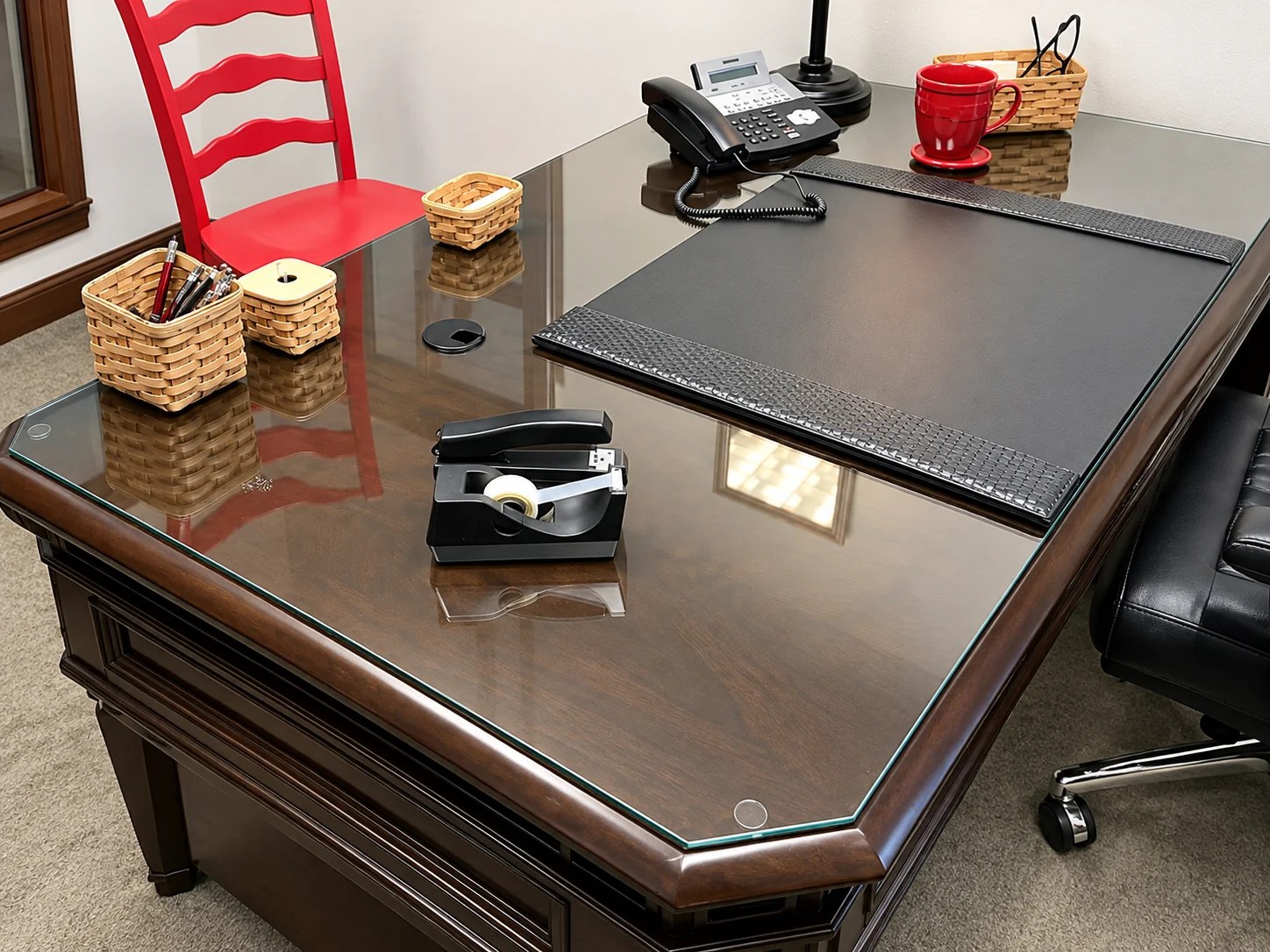
"What thickness should my glass table top be?" is the first question for any custom top — and the answer depends on one thing: whether the glass is protecting a surface or being the surface. Here's the practical chart we use in the shop.
The thickness chart
- 1/4" (6mm) — protective covers over wood tables and desks, small side tables, shelves under a 24" span. Light and nearly invisible.
- 3/8" (10mm) — the all-around favorite: coffee tables, home-office desks, smaller dining tables, longer shelves. Substantial without being heavy.
- 1/2" (12mm) — freestanding glass dining tables, executive desks, conference tables, vanity tops. The visible thickness reads premium from across the room.
- 3/4" (19mm) — very large dining and conference tables, statement pedestal pieces where the glass itself is the design feature.
Each step up adds roughly 30–60% to the material cost — so thickness is worth choosing deliberately, not by default.
How much weight can it hold?
For tempered tops, rough real-world guidelines: a 1/4" top over a short span handles 20–25 kg; a 3/8" top over a medium span 50–60 kg; a 1/2" top over a large dining span 70–80 kg — always distributed, never concentrated at one point. Base design matters as much as thickness: trestle and four-leg bases spread load well; light decorative bases need checking. And the glass itself has weight — about 3.3 lbs per square foot per 1/4" of thickness, so a 96" × 42" top in 1/2" runs ~140 lbs. That's a two-person carry.
Why tempering is non-negotiable
For any load-bearing surface, spec tempered glass — it's about four times more impact-resistant than ordinary glass and crumbles into blunt pieces if it ever fails. The only exception is a purely protective layer over an existing solid surface, and even there, most homeowners choose tempered for peace of mind. One consequence: tempered glass can't be cut after processing, so dimensions and edge profiles are locked before fabrication. Measure carefully.
Edge finishes, briefly
- Flat polished — clean, modern, minimal
- Beveled — a classic angled edge that catches light
- Pencil/rounded — soft edge, family-friendly
"Thickness isn't about taste — it's about span, load, and whether the glass is the table or just its bodyguard."
Need a top cut to your table's exact shape — rounded corners, umbrella holes, outlet notches and all? See our custom cut glass or send us your measurements for a free quote.