
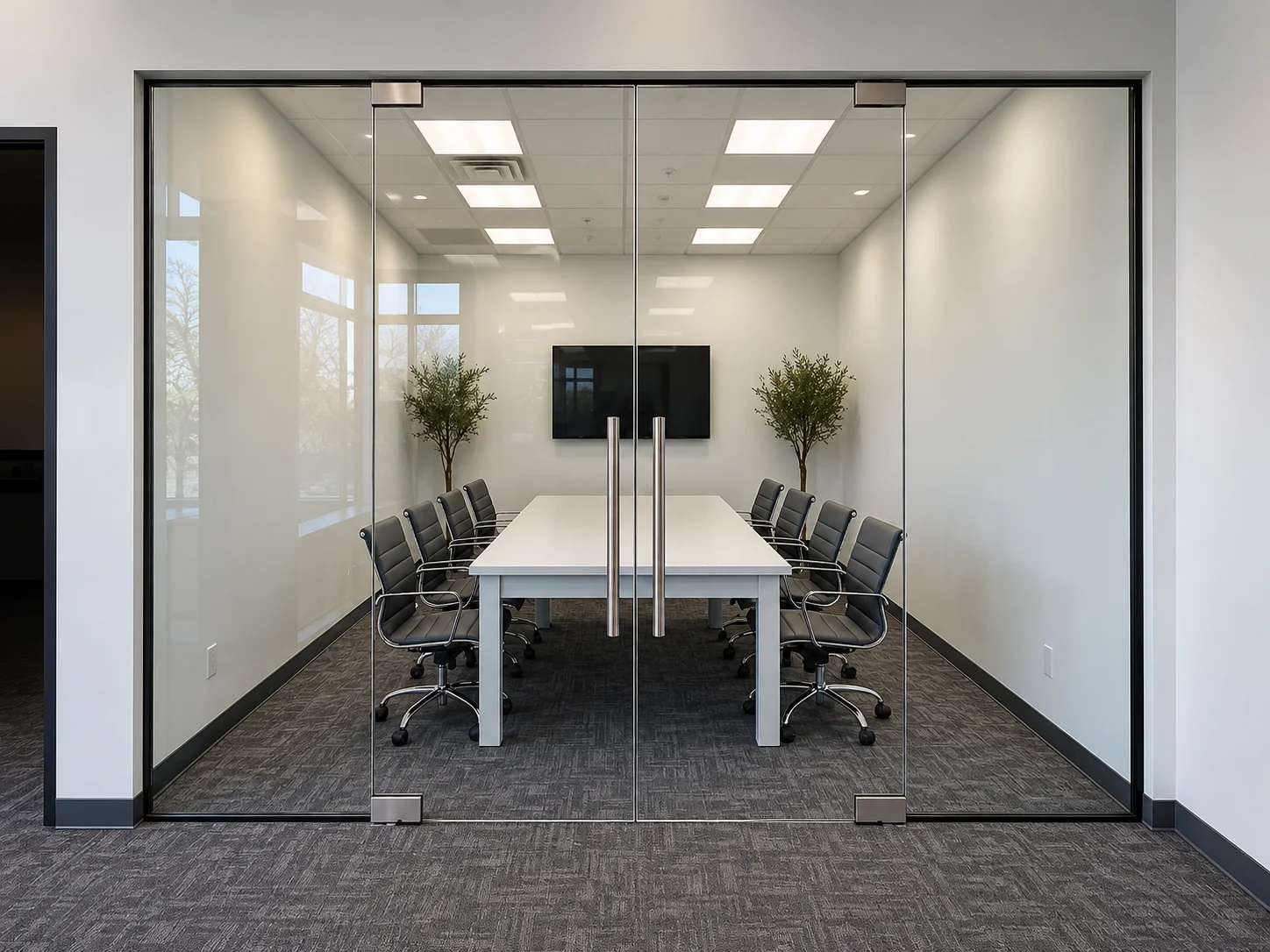
“But what about the noise?” is the question that decides most office glass projects. The truthful answer: glass can perform nearly as well as drywall — but the details decide everything.
How much sound does a glass wall actually block?
Sound blocking is measured in STC. A single 12 mm pane rates about STC 33–36 — conversation becomes muffled and unintelligible. Acoustic laminated glass reaches STC 40+, and double-glazed units exceed STC 45, in line with a standard stud-and-drywall wall.
Why do some glass offices still feel loud?
Because sound is lazy — it goes through gaps, not glass. The usual culprits: the 15 mm gap under an unsealed door, uncaulked perimeter joints, and a shared ceiling plenum above both rooms. Drop seals, full gasketing and plenum barriers fix all three for a fraction of the glass budget.
Is frosted or switchable glass quieter?
No — privacy films and frosting change light, not mass. Acoustic performance comes from thickness, lamination and air gaps. (Frosted glass is still the right call when the privacy you need is visual.)
What should we spec for a boardroom or HR office?
Our standard recommendation: acoustic laminated glass full-height to the deck above, a solid or fully gasketed glass door with a drop seal, and sealed perimeter joints. That combination delivers true confidential-conversation privacy.
Planning an office project? See our office glass systems or book a consultation — we’ll spec the acoustics to the room’s actual use.