
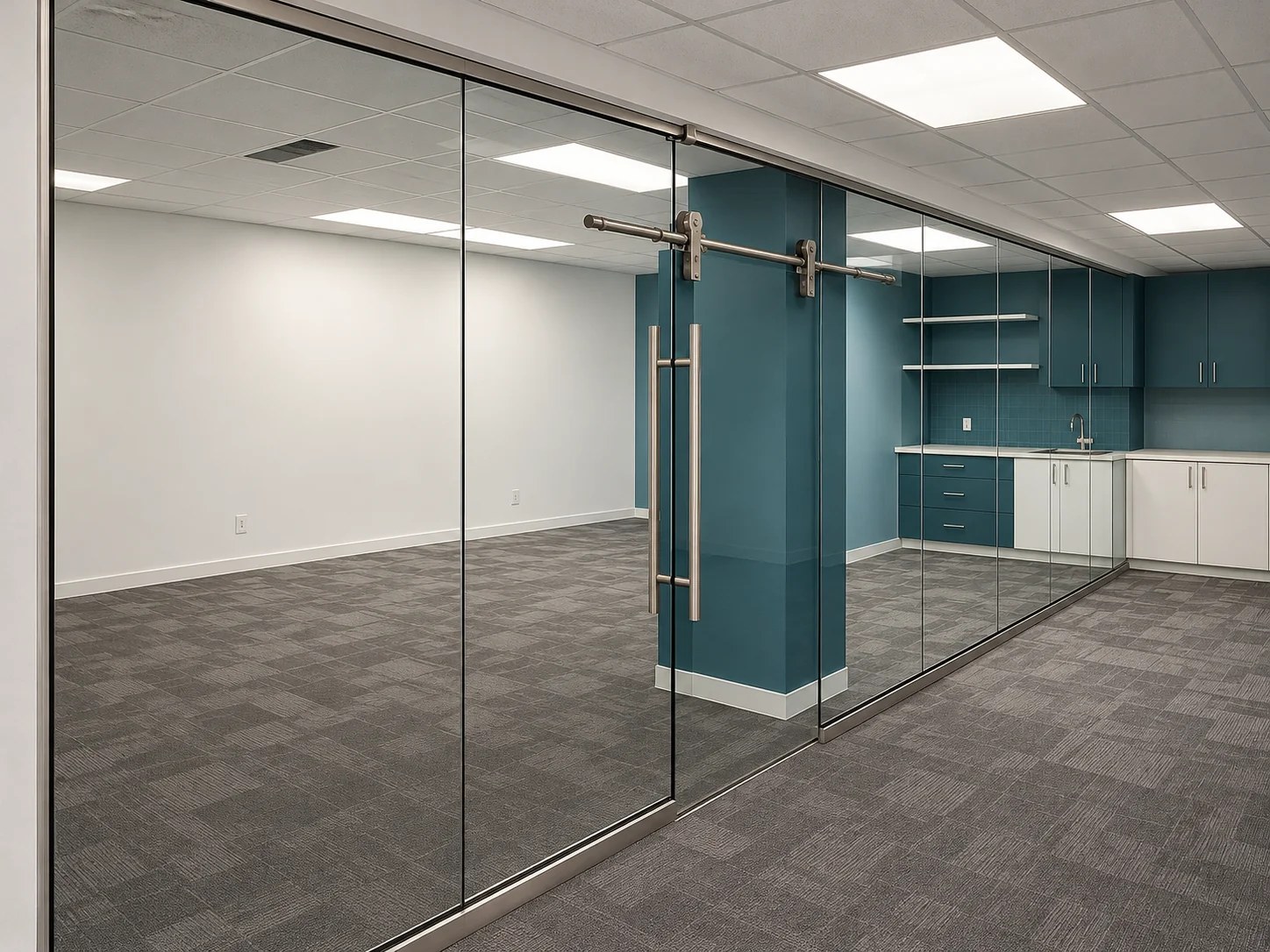
It's the number-one hesitation before any office glass project: "It looks great — but can people hear everything?" The precise answer: glass office walls can deliver strong acoustic privacy, but only when designed as a complete sealed system. A basic divider with gaps around it cannot. Here's what makes the difference.
First, the honest physics
No interior wall is perfectly soundproof — sound travels through glass, around frames, above ceilings and under doors. The real question is whether a glass wall can reduce speech transmission enough for the work happening inside. With the right assembly, yes: conference rooms can hold confidential calls, and private offices can feel genuinely private.
The four factors that actually control sound
1. The glass itself
Laminated acoustic glass — two sheets bonded with a sound-damping PVB interlayer — measurably outperforms standard tempered glass of the same thickness, typically adding 3–5 STC points and bringing a single-pane partition into the STC 35–38 range. For context: standard private offices usually need STC 35–40, and conference rooms 40+ for reliable speech privacy.
2. The seals — where most partitions fail
This is the part nobody photographs. Even the best acoustic glass underperforms if there are gaps at the floor track, ceiling line, or around the door. Doors are the biggest leak point in any glass wall, which is why properly fitted doors with quality sweeps and drop seals matter more than an extra millimetre of glass.
3. Framed vs. frameless
Framed systems generally outperform frameless on sound because frames create continuous contact for acoustic seals. Frameless systems with engineered perimeter gaskets can still perform well — but the detailing has to be deliberate, not decorative.
4. Full height vs. partial height
A partition that stops at 7 feet is a visual divider, not an acoustic one. Full-height, sealed systems are what deliver real privacy.
And visual privacy?
Sound isn't the only privacy that matters. Frosted glass — full-height or a frosted band at seated eye level — blocks sightlines while transmitting most of the daylight. Tinted and switchable glass go further. The right combination depends on whether you need visual privacy, acoustic privacy, or both — a boardroom usually needs both; a focus office may only need one.
What this means for your project
- Define the privacy target per room before choosing glass — conference room ≠ phone room ≠ open partition
- Budget for laminated acoustic glass where speech privacy matters
- Insist on seeing the door and perimeter seal details — that's where performance lives
- Expect a proper acoustic glass office to feel like a normal room, not an echo chamber
"Glass walls don't leak sound — gaps do. Seal the system and the glass takes care of the light."
We design and install office glass systems across Niagara and the GTA with clear, frosted and acoustic options — explore office glass systems or book a free on-site consultation and we'll spec the right assembly for each room.